


.png)
Are handmade soaps better? An honest answer from a soapmaker.
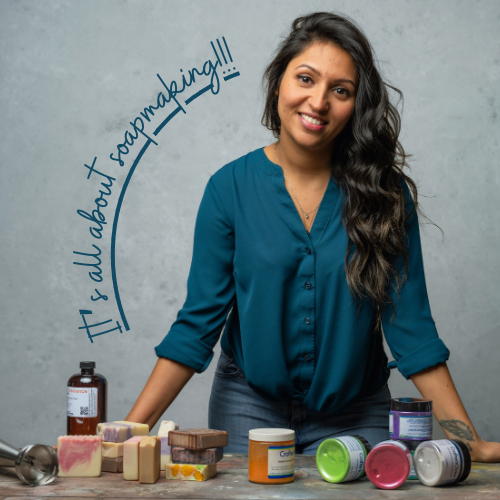
If you search online, you’ll find a lot of strong opinions about handmade soap. Some people claim it’s always better, while others say commercial soap works just fine.
As someone who has been making soap for years and teaching soap-making workshops at The Craft Space, my answer is a little more balanced:
Handmade soap can be better in many situations — but it depends on your skin and what you’re looking for.
Let’s break it down.
The Biggest Difference I Noticed When I First Tried Handmade Soap
When I first started making soap, the biggest thing that stood out to me was knowing exactly what went into it.

With handmade soap, I could see and choose every ingredient:
Olive oil
Coconut oil
Butters
Fragrances (or none at all)
That level of control meant I could create a soap specifically for my dry skin.
For example, I formulated my soap with a higher superfat level, which means extra oils remain in the finished soap. This helps make the soap more moisturizing and less drying than many commercial options.
That ability to customize a recipe for your skin type is something you usually don't get with store-bought soap.

Why People Love Handmade Soap in My Workshops
In our soapmaking workshops, participants get to choose whether they want their soap to be:
• completely natural• colorful with mica pigments• scented or unscented
Many people get excited when they see ingredients like olive oil, coconut oil, and butters going into their soap.
It’s a very different experience compared to buying a product with a long ingredient list you may not recognize.
People love knowing that what they’re making is simple and transparent.
The Biggest Misconception About Handmade Soap: Lye
One of the most common fears people have is about lye.
Many people think handmade soap contains leftover lye and that it’s dangerous.
But here’s the truth:
All real soap is made with lye.
Even commercial soaps use lye during the soap-making process.
Lye is necessary because it creates a chemical reaction called saponification.
During this reaction:
oils and butters react with lye
their chemical bonds break and reform
they create a completely new substance: soap and glycerin

When the measurements are correct and the process is done properly, there is no lye left in the finished soap.
Instead, what you have is:
soap
naturally produced glycerin
water that evaporates during curing
This is basic chemistry, but it’s one of the biggest misunderstandings people have about handmade soap.
Melt and Pour vs Cold Process Soap
Another common confusion is the difference between melt and pour soap and cold process soap.
Melt and Pour Soap
This soap base has already been made. Ingredients are added so the base can be melted again and customized with colors, scents, and designs.
It’s great for:
beginners
quick gifts
creative projects
Cold Process Soap
This is made from scratch using oils, butters, and lye.
With cold process soap, you can:
control every ingredient
design your own recipe
customize soap for specific skin needs
This is why many soap makers love cold process soap—it gives you complete creative and ingredient control.
Is Handmade Soap Always Better?
Honestly, not always.
There are situations where commercial soap may actually be better.
For example:
Some synthetic cleansers are extremely gentle.
That’s why certain baby washes use synthetic surfactants.
For babies under one year old, I personally recommend avoiding handmade soap because their skin can be very sensitive.

On the other hand, handmade soap can be a great option for people with:
dry skin
sensitive skin
eczema or psoriasis
In those cases, a simple handmade soap with no fragrance or additives may be less irritating than soaps containing ingredients like SLS (sodium lauryl sulfate), SLES and parabens.
So the real answer is:
The best soap depends on your skin.
The One Downside of Handmade Soap
Handmade soap is usually more expensive.
That’s because:
it’s made in small batches
ingredients are often higher quality
it’s produced by small businesses rather than large factories
Commercial soaps can be cheaper because they are produced in massive quantities.
So price can definitely be a factor.

Why I Fell in Love With Soap Making
I actually started making soap because I was bored and wanted a hobby.
But soap making quickly fascinated me because it combines two things I love: science and art.
Soap making is chemistry because you're working with chemical reactions.
But it’s also art because you can:
create colors
design patterns
experiment with textures and shapes
Once I learned how to create my own soap recipes, it became even more exciting. I could now formulate soaps specifically for different skin types.
That’s when I realized how powerful handmade soap could be.
Why Teaching Soap Making Became My Passion
After a few years of making soap, I thought about selling it.
But I realized something about myself:
I enjoy teaching more than selling.
That’s why I started hosting soap-making workshops at The Craft Space.
I love helping people:
learn a new skill
explore creativity
possibly even start their own soap businesses
For me, it’s a win-win. I get to share what I know, and they get a skill they can use for hobbies, gifts, or even a business.

Why Handmade Soap Is Special
One of the best things about soap making is that it creates something both creative and functional.
You’re not just making a craft that sits on a shelf.
You’re making something you can:
use daily
give as a gift
customize for any occasion
Cold process soap allows complete customization, while melt and pour soap allows quick creativity when you need something fast.
Either way, handmade soap turns a simple everyday product into something personal and meaningful.
Final Thoughts
So, are handmade soaps better?
Sometimes yes. Sometimes no.
But what makes handmade soap special is choice and control.
You can choose:
the ingredients
the scent
the design
the purpose of the soap
And that’s something you rarely get from a bar of soap on a supermarket shelf.
Let me know what type of soap do you use currently (handmade soap or commercial soap) and why?


Comments